Psychiatric Service Dogs vs Emotional Support Animals in North Dakota
This page explains the law in general terms. It is not legal advice. For a specific situation, contact the agency listed on this site or an attorney.
People often use the two terms as if they mean the same thing. In law they do not. The difference decides where an animal can go, what paperwork matters and what a North Dakota landlord or business may ask.
This guide compares a psychiatric service dog and an emotional support animal (ESA). It covers the ADA, housing, air travel and North Dakota law. It is a plain explanation of the law, not legal advice.
The short answer
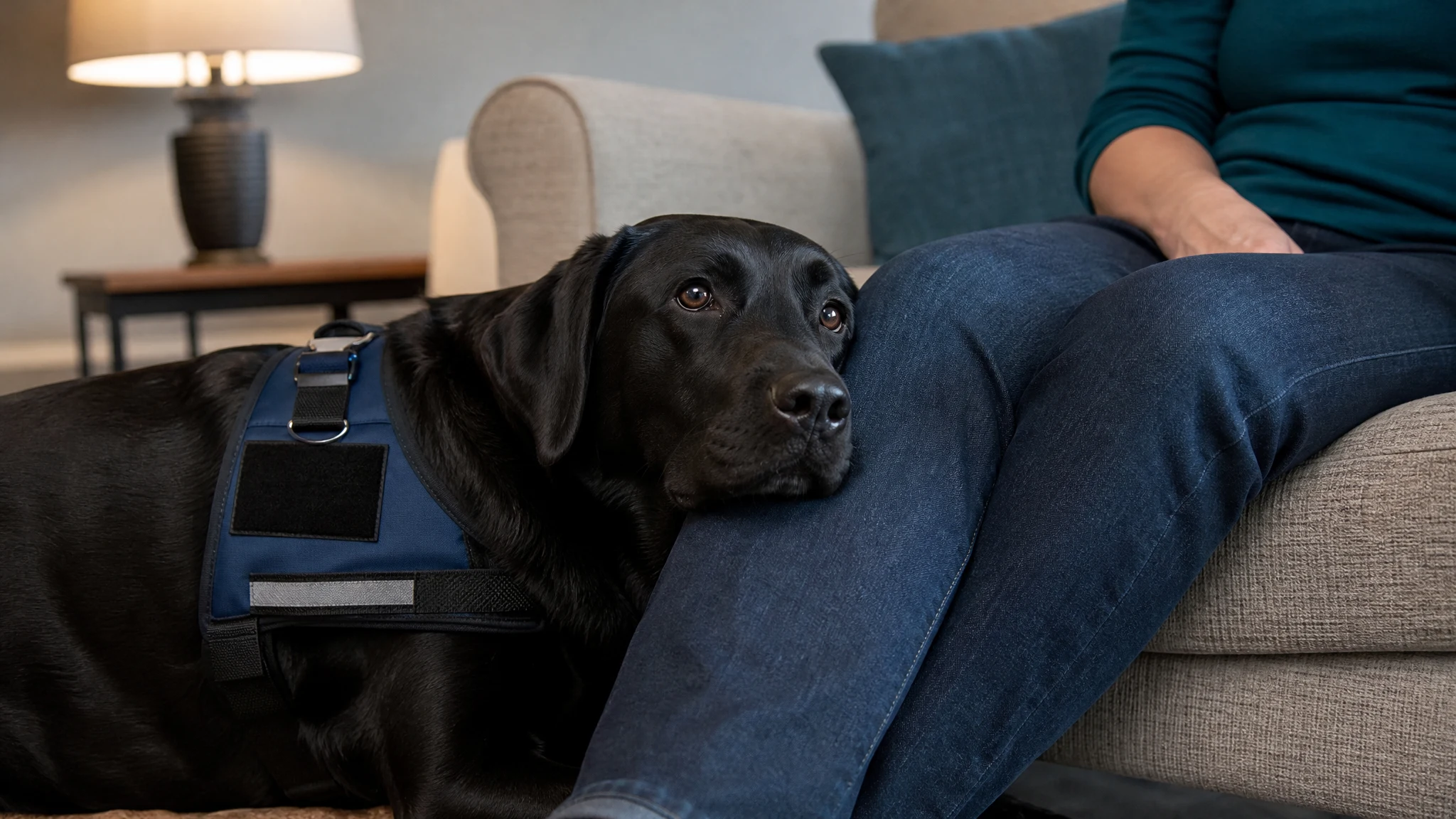
A psychiatric service dog is individually trained to do work or tasks for a person with a psychiatric disability. An emotional support animal gives comfort by being present and is not trained to perform a task. That training difference is the line the ADA draws.
The service dog vs emotional support animal question is therefore mostly a question of training and legal status, not of how much the animal helps. Many ESAs matter a great deal to their owners. They simply sit under different rules.
What the ADA says
ADA.gov defines a service animal as a dog that has been individually trained to do work or perform tasks for an individual with a disability. A psychiatric service dog fits this definition when it is trained to perform tasks tied to the person's disability.
The ADA does not treat emotional support, therapy or comfort animals as service animals. Providing comfort alone does not count as a trained task.
When a disability is not obvious, ADA.gov says staff at a business may ask only two questions:
- Is the dog a service animal required because of a disability?
- What work or task has the dog been trained to perform?
There is no official registry or required certification for service dogs under the ADA. A certificate, ID card or online registration is not legal proof of anything. This site does not link to sellers of such products.
What North Dakota law adds
North Dakota's service animal rules are in N.D. Cent. Code chapter 25-13. According to the Animal Legal & Historical Center's copy of the chapter, state law defines a service animal as a dog trained to do work, perform tasks or provide assistance for the benefit of an individual with a disability. The definition covers dogs only.
Under section 25-13-02, a person with a disability may be accompanied by a service animal in places of public accommodation without extra charge. The person is liable for damage the animal causes. Section 25-13-04 makes denying or interfering with that access a class A misdemeanor.
Section 25-13-02.1 covers a service animal in training. The trainer must notify the onsite manager, wear a photo ID card issued by a nationally recognized service animal training program, and accept liability for damage.
Section 25-13-02.2 makes it an infraction to knowingly claim that a pet is a service animal to gain entry to a public place or to obtain a reasonable housing accommodation. The fine amount is not confirmed in the source reviewed, so check the current Century Code at ndlegis.gov.
The chapter's service animal access provisions are written around dogs that are trained for a person's disability. An ESA is not described there as a service animal. Check ndlegis.gov for the current text.
Side-by-side comparison
| Attribute | Psychiatric service dog | Emotional support animal |
|---|---|---|
| Training | Individually trained to do work or tasks tied to a disability | No task training required |
| Species under the ADA | Dogs | Not a service animal under the ADA |
| Public access (stores, restaurants) | Covered by the ADA and N.D. Cent. Code 25-13-02 | No public access right under the ADA |
| Housing | Can be a disability-related accommodation request | Can be a disability-related accommodation request |
| Air travel | Governed by DOT rules; check DOT for current terms | Governed by DOT rules; check DOT for current terms |
| Registry or certification | None required by the ADA | None required |
| Questions a business may ask | The two ADA questions | Business may set its own pet policy |
Housing: rights for both, with documentation
Housing is where the two categories overlap most. Federal housing rules come from HUD, and North Dakota's housing rules are in the Century Code. Check HUD directly for the current federal guidance.
North Dakota Century Code 47-16-07.5 lets the landlord of a no-pets rental require reliable supporting documentation when a tenant claims a disability-related need for a service or assistance animal. Based on the version reproduced by the Animal Legal & Historical Center, documentation cannot be required when the disability or need is readily apparent or already known to the landlord. The current enacted text was not confirmed, so read it at ndlegis.gov.
Section 47-16-07.6 addresses fraudulent disability documentation. A bought online letter or certificate is not a safe shortcut. Documentation that is genuine and tied to a real disability-related need is the point of the rule.
In 2025, Senate Bill 2193 would have amended sections 25-13-01.1 and 47-16-07.5. According to the North Dakota Legislative Assembly, it failed in the House, with 12 yeas and 81 nays. The existing rules remain the ones to follow.
Air travel
Air travel is governed by the U.S. Department of Transportation under the Air Carrier Access Act. DOT revised its rules in 2020, and airlines publish their own procedures for forms and advance notice. Check DOT and your airline before you book, because requirements can change and this guide does not restate them.
Psychiatric service dog: pros and cons
Pros
- Clear legal status under the ADA and North Dakota law when the dog is trained for tasks.
- Public access to places that otherwise allow no pets, with the handler responsible for the dog's behavior and any damage.
- Tasks are built around the person's specific needs.
Cons
- Training takes substantial time and effort, whether through a program or an owner-trained path.
- The dog must behave reliably in public, and the handler is responsible for it.
- Program costs and waitlists are not published in the sources reviewed, so ask each program directly.
Emotional support animal: pros and cons
Pros
- No task training is required, so the animal can be a companion already in the home.
- Housing accommodation requests are possible with reliable documentation.
- Species flexibility in housing, since the ADA's dog-only definition does not apply to a housing request. Ask HUD for the current rules.
Cons
- No ADA public access right, so shops, restaurants and other businesses can say no.
- Air travel treatment is set by DOT rules and airline policy, which may be more limited.
- Presenting an ESA as a service animal to gain entry can be an infraction under N.D. Cent. Code 25-13-02.2.
Finding a psychiatric service dog in North Dakota
A psychiatric service dog in North Dakota can come from a program or be trained by its handler. For program options, these are the ones with published information:
- Service Dogs for America in Jud, formerly the Great Plains Assistance Dogs Foundation. It says it is accredited to train mobility, emergency medical response and PTSD service dogs. Applicants must live in the lower 48 states and travel to the Jud campus. It notes staffing shortages and publishes no prices.
- Patriot Assistance Dogs in Detroit Lakes, Minnesota. It provides psychiatric service dogs to qualified U.S. military veterans, and the Assistance Dogs International directory lists North Dakota among its service states.
- Believet Canine Service Partners in Northfield, Minnesota. Its stated mission is service dogs for veterans with PTSD, TBI and other disabilities.
Veterans may also look at the North Dakota Department of Veterans Affairs Service Dog Grant for ND Veterans with PTSD. The department's page lists these requirements: North Dakota residency, a PTSD diagnosis, ongoing counseling or therapy and a doctor's recommendation. Dogs come from Service Dogs for America. The page is undated, so confirm current funding with the department.
A January 2026 KFYR report said federal funding for the Wounded Warrior Service Dog Program was cut, which affected North Dakota veteran-serving nonprofits. Ask any program about its current status, costs and wait times.
For a broader look at training, programs and costs, see our guide to service dog training in North Dakota.
Best for: by use case
- You need your dog with you at work errands, stores and restaurants: a psychiatric service dog, because the ADA and N.D. Cent. Code 25-13-02 cover public access for trained service dogs.
- You mainly need a pet-friendly home: either can support a housing accommodation request. Be ready to provide reliable documentation if the need is not apparent.
- Comfort at home is the main need and the animal is not trained for tasks: an ESA fits, with the understanding that public places can set their own pet rules.
- You are a North Dakota veteran with PTSD: ask the Department of Veterans Affairs about the service dog grant and the programs above.
- You travel by air: check DOT and your airline first, whichever category applies.
Verdict
If a dog is trained to perform tasks that help with your psychiatric disability, it is a service dog and carries the strongest legal footing in North Dakota, both in public places and in housing. If the animal provides comfort without task training, it is an ESA. It can still be part of a housing accommodation request but has no ADA public access right.
The honest choice depends on what you need the animal to do and where. Do not buy a registration or certificate to bridge the gap. It has no legal weight under the ADA, and knowingly misrepresenting a pet as a service animal can be an infraction under North Dakota law.
If access is denied
The North Dakota Department of Labor and Human Rights, Human Rights Division, handles complaints about public accommodation, housing and employment discrimination. Its address is 600 East Boulevard Ave Dept 406, Bismarck, ND 58505-0340. The phone number is 701.328.2660, or toll-free 1-800-582-8032. Ask the department about filing deadlines.
Sources
- ADA.gov, Frequently Asked Questions about Service Animals and the ADA
- Animal Legal & Historical Center, North Dakota assistance animal and guide dog laws
- North Dakota Legislative Assembly, SB 2193 bill overview
- ND Department of Labor and Human Rights, How to File a Discrimination Complaint
- North Dakota Department of Veterans Affairs, Service Dog Grant for ND Veterans with PTSD
- Service Dogs for America
- Patriot Assistance Dogs
- Believet Canine Service Partners