Service Dog Tasks and the Public Access Test, Explained
This page explains the law in general terms. It is not legal advice. For a specific situation, contact the agency listed on this site or an attorney.
If you are training a service dog in North Dakota, two questions come up early. What counts as a task? And what is the public access test? This guide answers both in plain terms, then walks you through building tasks and preparing for a public access assessment step by step.
One point first. The public access test is a training benchmark. It is not a legal requirement under the ADA, and passing it does not create a legal status. Tasks, on the other hand, sit at the center of the legal definition.
What counts as a service dog task
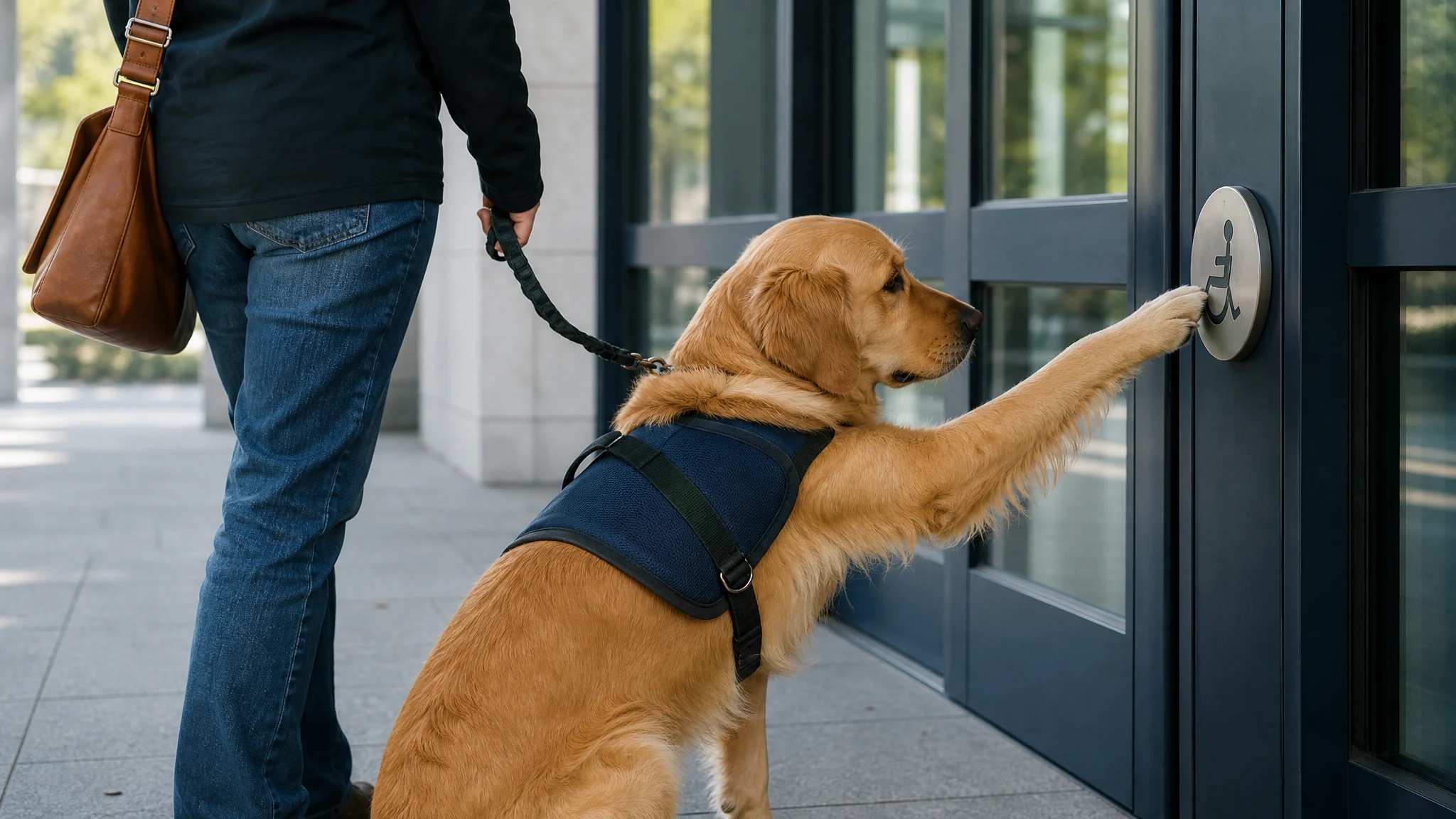
ADA.gov says a service animal is a dog that has been individually trained to do work or perform tasks for an individual with a disability. North Dakota law, in N.D. Cent. Code ch. 25-13, uses similar language. It defines a service animal as a dog trained to do work, perform tasks, or provide assistance for the benefit of an individual with a disability. Under the state definition, only dogs are covered.
The key idea is that the work or task is directly related to the person's disability. The dog does something the person needs because of that disability. It is trained to do it on purpose, and it does it reliably.
Examples of tasks by type of disability
People often ask what tasks a service dog can do. The list is long and depends on the handler's needs. These are common examples of the kind of work involved:
- Mobility disabilities: retrieving dropped items, opening or closing doors, pulling a manual wheelchair, or providing balance support when the handler stands.
- Vision or hearing disabilities: guiding around obstacles, or alerting the handler to a specific sound such as a smoke alarm or a person calling their name.
- Seizure or medical conditions: responding to a seizure by staying with the handler or fetching help, or alerting to a medical change the dog has been trained to signal.
- Psychiatric disabilities such as PTSD: interrupting a trained-for behavior like a panic response, turning on lights in a room, or creating space in a crowd on cue.
- Diabetes: alerting to a change the dog has been trained to notice, or fetching supplies.
These are examples, not an official list. The ADA.gov service animal FAQ is the place to confirm the definition itself.
Why comfort alone is not a task
ADA.gov is clear that emotional support, therapy and comfort animals are not service animals under the ADA. A dog that calms someone simply by being near them is doing something valuable, but the ADA does not call that a task.
The difference is trained action. A dog that lies across a handler's lap on a trained signal to ease a panic episode is doing deep pressure work it was taught. A dog that is comforting because of its personality is not performing a task. If you are unsure which side your dog falls on, ask whether you can name a specific, trained behavior that responds to a specific need caused by the disability.
What the public access test is, and what it is not
Assistance Dogs International (ADI) is the accrediting body behind several programs in this region, including Service Dogs for America in Jud, North Dakota, which is listed as ADI accredited. ADI publishes a public access standard for assistance dogs. Programs use it to check that a dog behaves safely and calmly in public places.
Many handlers and trainers use that kind of assessment as a goal for owner-trained dogs too. It is a good way to see whether your dog is ready for stores, offices and restaurants.
It is not an ADA rule. The ADA does not require a service dog to pass any test, hold a certificate or appear in a registry. ADA.gov says staff at a business may ask only two questions when it is not obvious what the dog does:
- Is the dog a service animal required because of a disability?
- What work or task has the dog been trained to perform?
Staff may not demand documentation. Nothing you buy online, including an ID card or registration, is legal proof. This site does not recommend those products.
Even so, a dog that is not under control can be asked to leave. A public access benchmark helps you train for that real-world standard.
Materials you will need
- A flat buckle collar or a well-fitted harness, plus a standard leash. Use only humane, reward-based tools. Shock, prong and choke collars are not part of ethical training and are not recommended.
- Small, soft, high-value treats that your dog can eat quickly.
- A clicker or a consistent marker word, if you use one.
- A treat pouch and a mat or small blanket for settling practice.
- A notebook or phone notes to log each session and each task.
- Access to a range of public spaces where you have permission to practice, and a helper for distraction work.
- A written list of your disability-related needs, so each task you train matches one of them.
Step-by-step: building tasks and preparing for a public access test
Step 1: Match each task to a need
Write down the specific barriers your disability creates. Then list one trained behavior that addresses each. For example, "cannot bend to pick up dropped items" might lead to a retrieve task. Keep the list short at first. A few reliable tasks are better than many shaky ones.
Step 2: Build basic manners first
Before any task work, teach sit, down, stay, loose-leash walking, come when called, and a settle on a mat. Reward calm behavior often and generously. These skills carry into every public access scenario, so give them time.
Step 3: Teach each task in small pieces
Break the task into tiny steps and reward each one. To teach a retrieve, you might first reward looking at the item, then touching it with the nose, then mouthing it, then carrying it, then delivering to hand. Move on only when the dog is succeeding most of the time. If the dog struggles, go back one step.
Step 4: Put the task on cue
Add a verbal cue or a hand signal once the behavior is steady. For alert tasks, teach the dog to respond to the trigger rather than to a cue from you. Work with a trainer who uses reward-based methods if you need help. This is where good guidance saves a lot of frustration.
Step 5: Practice in new places
Dogs do not generalize easily. A task that is perfect in your kitchen may fall apart in a parking lot. Repeat each task in different rooms, then outdoors, then in quiet public places, then busy ones. Lower your expectations a little in each new place and reward generously.
Step 6: Work through the public access skills
Practice the behaviors a public access assessment typically looks at. Check ADI directly for the current standard, since details can change. In general, work on these skills:
- Walking calmly beside you through doorways, aisles and crowds.
- Ignoring food, dropped items and other people.
- Settling under a table or beside a chair for a long period.
- Staying calm around other animals, carts, noises and sudden movements.
- Staying clean and relaxed during grooming and handling.
- Not barking, sniffing merchandise, or soliciting attention.
- Staying focused on you when you ask.
- Performing a trained task on cue while in public.
Step 7: Add distractions slowly
Ask a helper to drop a clatter of keys, roll a cart past, or walk by with a friendly dog at a distance. Start far away and move closer over many sessions. If your dog stares, lunges or freezes, you moved too fast. Increase distance and reward calm.
Step 8: Do a mock assessment
Walk a route you have designed, with a helper watching. Note where the dog loses focus, then train those spots. Repeat until the dog handles the route with relaxed behavior most of the time. A real assessment, if you pursue one through a program, may be scored differently, so ask that program how it works.
Tips and common mistakes to avoid
- Do not skip the task list. A dog that is only well behaved and has no trained task is a pet in the eyes of the ADA, however good its manners.
- Do not rely on a vest or card. Gear can help the public understand, but the ADA does not require it, and it proves nothing about training.
- Do not rush public outings. A dog that is overwhelmed learns the wrong lessons. Short, successful trips are better than long, stressful ones.
- Do not use punishment. The American Veterinary Society of Animal Behavior (AVSAB) supports reward-based training. Aversive methods can increase fear and anxiety, which works against public access.
- Do not mix up comfort and tasks. If your dog helps you feel calmer, that is good. Still, only trained work tied to your disability counts as a task.
- Do not overlook rest. Working dogs need breaks, play and sleep. Tired dogs make mistakes.
- Do not misrepresent a pet. North Dakota law, N.D. Cent. Code 25-13-02.2, makes it an infraction to knowingly claim a pet is a service animal to gain entry to a public place or obtain a housing accommodation under 47-16-07.5. Check ndlegis.gov for the current penalty.
North Dakota rules that touch this topic
Under N.D. Cent. Code 25-13-02, a person with a disability may be accompanied by a service animal in places of public accommodation without extra charge. The handler is liable for damage the animal causes. Section 25-13-04 makes denying or interfering with access a class A misdemeanor, with a carve-out for denials covered by 25-13-02. Read the statute on ndlegis.gov for the exact wording of covered places.
Section 25-13-02.1 covers a service animal in training. The trainer must notify an onsite manager, wear a photo ID card issued by a nationally recognized service animal training program, and be liable for damage. After notice, the manager may not deny admission without good cause. If you are owner-training, this section may not fit your situation, so confirm the details before you rely on it.
For rental housing, N.D. Cent. Code 47-16-07.5 lets a landlord of a no-pets rental require reliable supporting documentation when a tenant claims a disability-related need for a service or assistance animal. Landlords generally cannot require it when the disability or need is readily apparent or already known. Check the current text on ndlegis.gov.
If you believe you were wrongly denied access, the North Dakota Department of Labor and Human Rights, Human Rights Division, takes complaints about public accommodation, housing and employment discrimination. The mailing address is 600 East Boulevard Ave Dept 406, Bismarck, ND 58505-0340. The phone number is 701.328.2660, or 1-800-582-8032 toll free. This article is not legal advice. Deadlines apply to complaints, so ask the agency about timing.
For a wider view of state law, programs and costs, see our guide to service dog training in North Dakota: laws, programs and costs.
Help with training in and near North Dakota
Service Dogs for America in Jud is ADI accredited and trains mobility, emergency medical response and PTSD service dogs. Its site says applicants must live in the lower 48 states and travel to the Jud campus, and it does not publish prices. Contact the program for costs and waitlists.
North Dakota veterans with PTSD can look at the North Dakota Department of Veterans Affairs service dog grant. Its requirements include North Dakota residency, a PTSD diagnosis, counseling or therapy, and a doctor's recommendation. The page is undated, so confirm current funding with the department. Patriot Assistance Dogs in Detroit Lakes, Minnesota, also serves veterans with psychiatric service dogs, and its ADI listing includes North Dakota. Ask each program about fees and wait times.
What results to expect
With steady, reward-based practice, many dogs can learn reliable tasks and calm public behavior. Timelines vary a great deal by dog, by task and by handler. Some tasks come together in weeks. Others can take many months of practice, and some dogs may not suit service work at all.
A well-prepared team may find public outings smoother and less stressful, and may feel more confident when someone asks the two permitted questions. No training plan can promise a particular outcome, and a mock or formal assessment is a snapshot, not a lifetime guarantee. Keep practicing, keep rewarding, and reassess your dog's comfort regularly.
Sources
- ADA.gov, Frequently Asked Questions about Service Animals and the ADA
- Animal Legal & Historical Center, North Dakota assistance animal and guide dog laws (N.D. Cent. Code ch. 25-13)
- North Dakota Legislative Assembly, N.D. Cent. Code chapter 25-13
- North Dakota Department of Labor and Human Rights, How to File a Discrimination Complaint
- Service Dogs for America
- North Dakota Department of Veterans Affairs, Service Dog Grant for ND Veterans with PTSD
- Assistance Dogs International, member directory